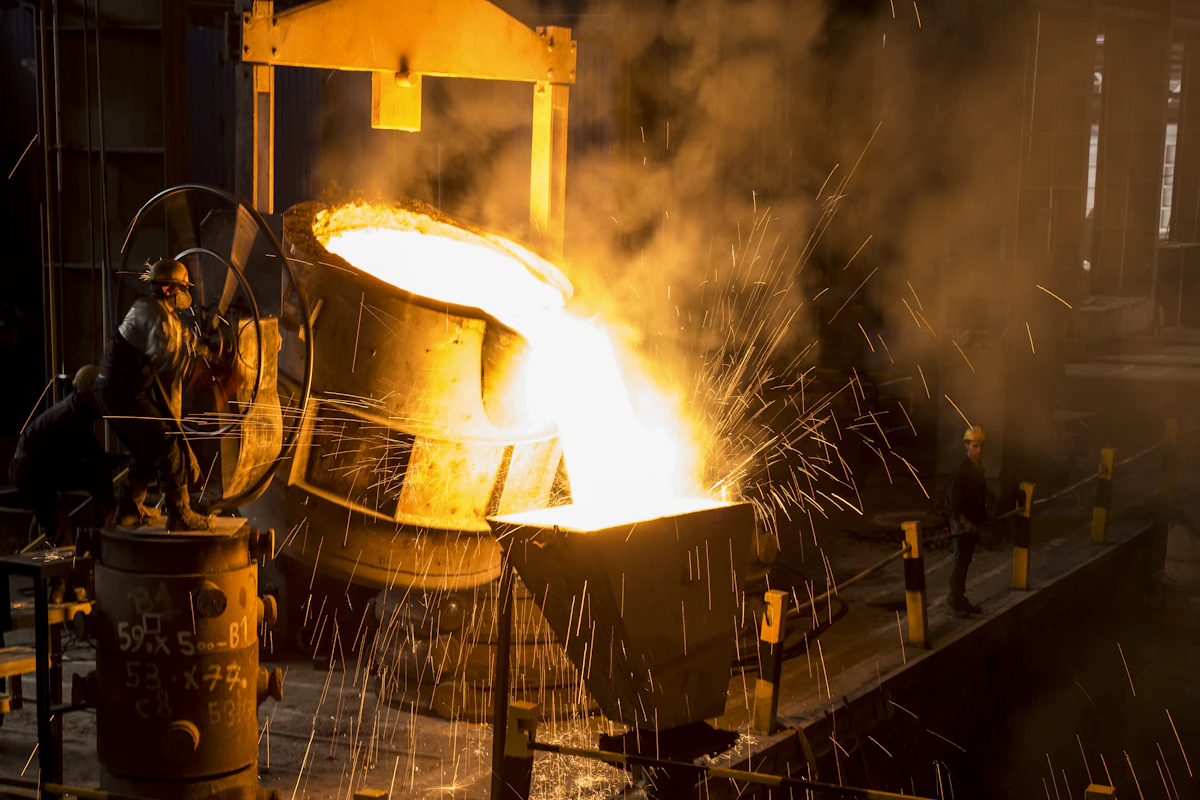
Purpose and Process Overview
The ladle furnace is a refractory-lined steel ladle fitted with a retractable roof carrying three graphite electrodes. After steel is tapped from the BOF or EAF — typically at a composition deliberately held short of final specification — the ladle is transferred to the LF station where arc heating, slag chemistry adjustment, alloy additions, and argon stirring are used to achieve precise final temperature, composition, and inclusion cleanliness. The LF acts as a thermal and chemical buffer between primary steelmaking and the continuous caster, absorbing scheduling variations and enabling the caster to run at a steady pace with consistent steel quality. Treatment time is typically 20–60 minutes.
Arc Heating
Graphite electrodes are lowered through the roof into contact with the slag layer, and an arc is struck that heats the bath through the slag. Heating rates of 3–5 °C/min per MW of installed transformer power are typical; a 60 MW LF can reheat a 300 t heat at approximately 4–7 °C/min. The arc is shielded from the ladle shell by a foamy, high-basicity slag — a necessity because ladle shell radiation damage would otherwise limit the arc power that can be applied. Unlike the EAF, there is no intention to melt material; the electrode tips are kept in or just above the slag, not in contact with the steel.
Slag Chemistry and Desulphurisation
The LF slag is the key tool for desulphurisation. A highly basic (CaO/SiO₂ > 3.0), low-FeO (<1%), fluid slag maximises the sulphur partition coefficient (Ls = [%S]slag/[%S]steel) to values of 300–600, enabling desulphurisation from an initial 0.020–0.030% S (as tapped from the BOF or EAF) to below 0.005% S, and below 0.001% S for demanding grades such as linepipe, bearing steel, and tyre cord. Achieving this requires pre-deoxidation (aluminium killed steel), argon stirring to ensure slag-metal contact, and addition of a lime–fluorspar (CaF₂) flux to reduce slag viscosity. CaF₂ addition is strictly controlled due to its effect on refractory wear and its environmental classification.
Alloy Additions and Trim
Fine chemistry adjustments — trimming Mn, Si, Cr, Ni, Mo, Nb, V, Ti — are made in the LF using ferroalloy additions (FeMn, FeSi, FeCr) and master alloys added by conveyor, pneumatic injection, or hand addition. Wire injection using a cored-wire feeder allows precise additions of calcium silicide (SiCa), calcium metal, carbon, or aluminium in wire form, at a controlled feed rate of 1–4 m/s through a guide tube directly into the bath below the slag layer. Calcium wire injection is used to modify alumina inclusions to liquid calcium aluminate, improving castability and preventing nozzle clogging at the continuous caster.
Argon Stirring
Argon is blown through one or two porous plugs in the ladle floor throughout the LF treatment. The rising argon plume creates a toroidal circulation pattern that homogenises the bath temperature and composition, promotes slag-metal contact for desulphurisation and inclusion absorption, and floats alumina and other non-metallic inclusions to the slag surface. Stirring intensity must be controlled: too vigorous stirring exposes the metal surface (open eye), causing reoxidation and nitrogen pickup; too gentle results in poor homogeneity. Typical argon flow rates are 3–8 Nl/min/t.
LF Is Present at Virtually Every Modern Steelplant
The ladle furnace is often overlooked in descriptions of steelmaking routes because it is not always listed in public capacity data. However, any plant producing quality flat-rolled, structural, or tubular grades operates at least one LF. It is as universal to modern steelmaking as the continuous caster itself. Plants without an LF are limited to producing low-specification commodity grades where tight temperature and chemistry control are not required.