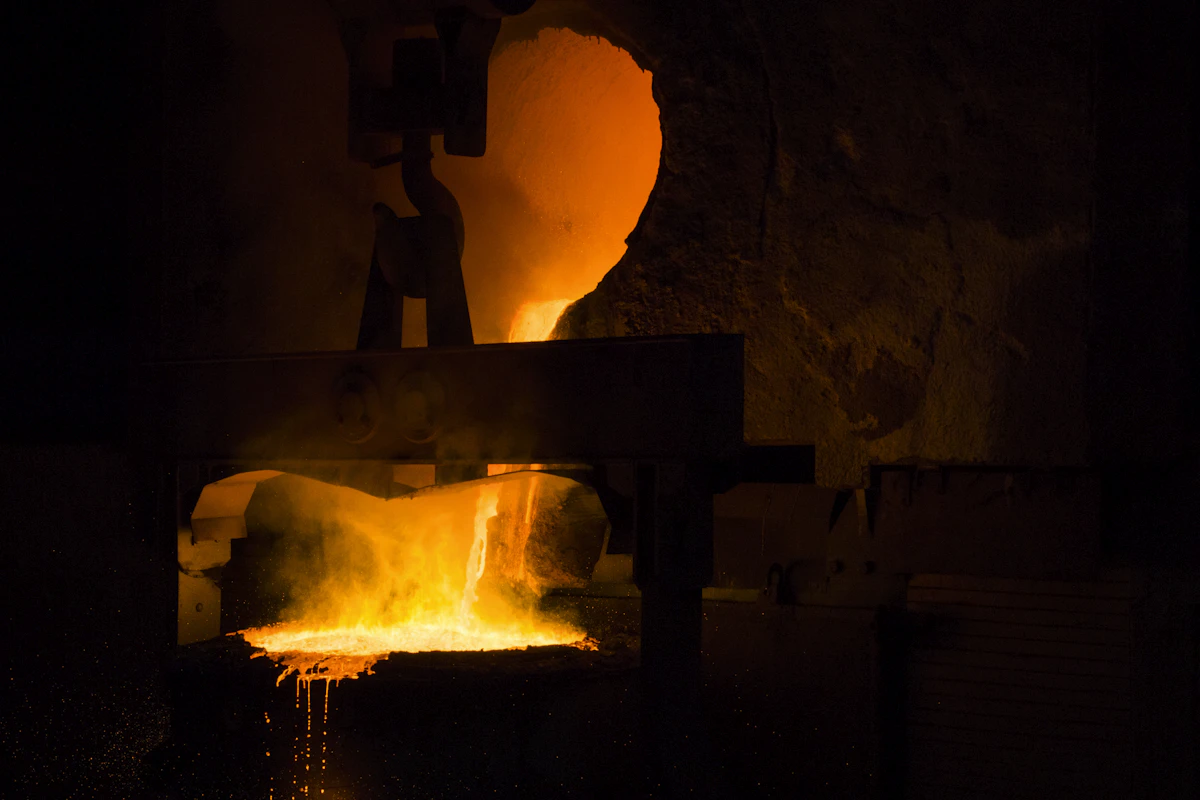
Process Overview
Direct reduction converts iron ore to metallic iron by reacting iron oxides with a reducing gas (H₂ + CO mixture, or pure H₂) at temperatures of 800–1,050 °C — well below the melting point of iron. Because no melting occurs, the product retains the shape of the input pellets or lump ore. The resulting material — called Direct Reduced Iron (DRI) when discharged at ambient temperature, or Hot Briquetted Iron (HBI) when compacted at >650 °C into pillow-shaped briquettes — typically contains 90–94% total iron with a metallization degree of 88–95%. DRI is the primary feedstock for EAF-based flat-rolled steel production in regions where scrap quality is insufficient for automotive and other demanding grades.
Gas-Based Shaft Furnace: Midrex and HYL/Energiron
The dominant direct reduction technology is the counter-current shaft furnace. The Midrex process — accounting for roughly 60% of global DRI output — feeds pellets or lump ore into the top of a vertical shaft and circulates reformed natural gas (H₂:CO ratio approximately 1.5:1) upward through the burden. Pellets descend through a reduction zone at 800–950 °C over 4–6 hours before being discharged. The Energiron (formerly HYL) process operates at higher pressures (4–8 bar) and temperatures (up to 1,050 °C), uses an internal reformer, and can tolerate a higher proportion of H₂ in the reducing gas — making it better suited to hydrogen-enriched or pure-H₂ operation. Both processes require high-grade iron ore pellets (>67% Fe) to keep gangue (SiO₂ + Al₂O₃) below 4–5%, otherwise the EAF energy consumption increases sharply.
Hot Briquetted Iron (HBI)
DRI discharged at ambient temperature is pyrophoric — it can spontaneously oxidise and heat in air, particularly when wet, making ocean shipping hazardous. HBI is produced by compressing hot DRI at >650 °C in roller presses to form dense (5.0–5.5 g/cm³) pillow-shaped briquettes. The high density and low surface area greatly reduce reactivity, making HBI safe for bulk ocean transport. ArcelorMittal's HBI plant in Texas and voestalpine's in Louisiana supply HBI from US Gulf Coast natural gas to European EAF operations, establishing a global market for solid iron metallics.
Coal-Based Direct Reduction
Where natural gas is unavailable or expensive — most notably in India — coal-based direct reduction using rotary kilns (SL/RN process) accounts for a significant share of DRI production. Iron ore lumps and non-coking coal are charged to a rotating inclined cylindrical kiln and heated to 900–1,050 °C over a residence time of 8–12 hours. Productivity is lower than gas-based shaft furnaces, and product quality (metallization 85–90%, higher sulphur) is less consistent. India produces approximately 45 million tonnes per year of coal-based DRI, making it the world's largest DRI producer.
Hydrogen DRI and Decarbonisation
Replacing reformed natural gas with green hydrogen as the sole reductant eliminates the CO₂ generated by the carbon-bearing reducing gas. The reaction Fe₂O₃ + 3H₂ → 2Fe + 3H₂O produces only water vapour as a by-product. The HYBRIT project (SSAB, LKAB, Vattenfall) in Sweden produced the world's first fossil-free steel in 2021 using this route. H2 Green Steel (Boden, Sweden), ArcelorMittal Hamburg, and Salzgitter's SALCOS project are all targeting commercial-scale H₂-DRI-EAF production in the late 2020s. The primary barrier is the availability and cost of green hydrogen at the scale needed: a 2 Mt/yr DRI plant requires approximately 180,000 t/yr of H₂.
DRI as Scrap Substitute in the EAF
In scrap-constrained markets — particularly the Middle East and South Asia — EAF operators rely on DRI to dilute the tramp element content (Cu, Sn, Ni) that accumulates in scrap-based melts. Tramp copper above ~0.12% causes surface hot-shortness in hot-rolled products and is essentially irreversible once in the melt. DRI, being produced directly from ore, contains negligible tramp elements, enabling the production of deep-drawing quality flat-rolled and automotive grades from EAF routes that would otherwise be limited to long products.